NSW CPD requirements have changed for the 2026–27 CPD year
NSW property professionals need to pay close attention to their Continuing Professional Development obligations for the 2026–27 CPD year, with several licence categories now facing higher minimum training hours.
NSW Fair Trading’s current guidance confirms the CPD year runs from 1 July 2026 to 30 June 2027, and that obligations vary by licence category and area of practice.
What has changed for 2026–27?
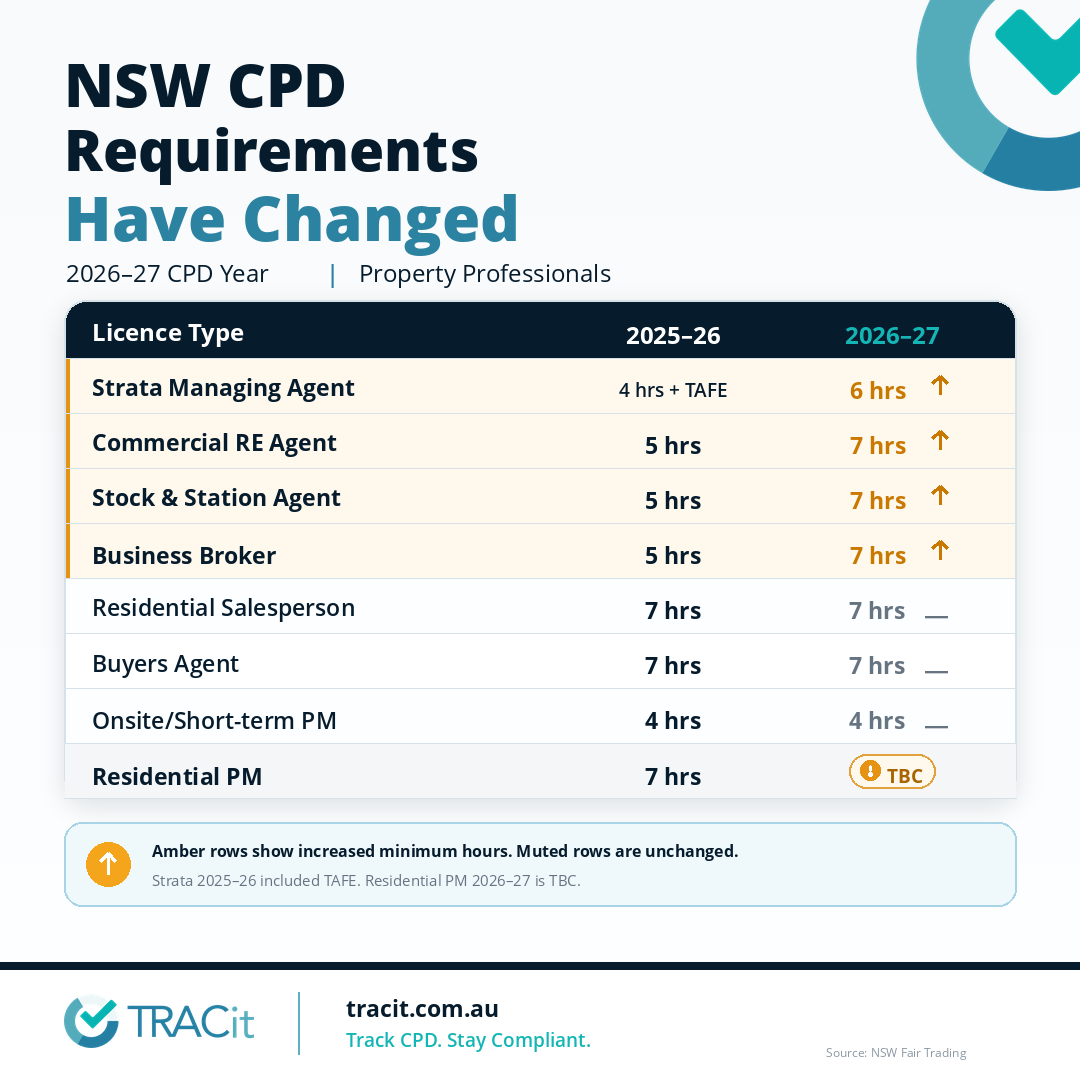
For the 2026–27 CPD year, minimum interactive training requirements include:
- Strata managing agents: increased to 6 hours.
- Commercial real estate agents: increased to 7 hours.
- Stock and station agents: increased to 7 hours.
- Business brokers: increased to 7 hours.
- Residential real estate salespeople: remains 7 hours.
- Buyers agents: remains 7 hours.
- Onsite / short-term residential property managers: remains 4 hours.
NSW Fair Trading says details for residential property manager CPD topics, including minimum hours and the Domestic Violence reforms topic, are still being finalised and will be published separately.
Dual licence holders need extra care
For dual licence holders, the answer depends on the licence combination and area of practice.
NSW Fair Trading’s guidance says people with multiple licence categories must maintain knowledge and skill across each current category they hold. Where mandatory topics are shared, agents may not need to repeat the same topic if all required learning outcomes are met. Where there are no shared topics, the minimum hour requirement for each licence category or area of practice remains.
That means agencies should avoid assuming one generic CPD plan will work across the whole team. For example, NSW Fair Trading lists real estate and strata dual licence holders as needing the relevant real estate CPD plus the 6 hours of strata CPD. A residential salesperson who also holds a strata managing agent licence should plan for 7 hours + 6 hours unless advised otherwise by an approved provider.
Real estate and stock and station combinations also need to be checked carefully against the current guidance, because the total requirement may depend on the person’s area of practice and any shared topics.
Plan earlier, especially for mixed teams
The key takeaway for agencies is simple: CPD planning needs to happen earlier, especially for teams with mixed licence categories.
A one-size-fits-all approach may no longer be enough to keep every licence holder on track. Agencies should map each team member’s licence category, area of practice and CPD status before training deadlines start to create last-minute pressure.
TRACit helps agencies track CPD obligations, monitor completion and reduce the risk of missed training, licence issues or messy end-of-year compliance follow-up.
The earlier you know what each person needs, the easier it is to stay compliant.